How to Measure the Success of a Brand Identity: What Makes It Strong?
Brand identity success is not measured by the team liking its logo. A strong identity helps people identify the brand, works consistently across channels, and remains clear when language or screen size changes. Measurement needs defined metrics, an appropriate sample, and a baseline for comparison.
Key Takeaways
Separate audience perceptions, visual asset performance, implementation quality, and marketing results; each needs a different measurement method.
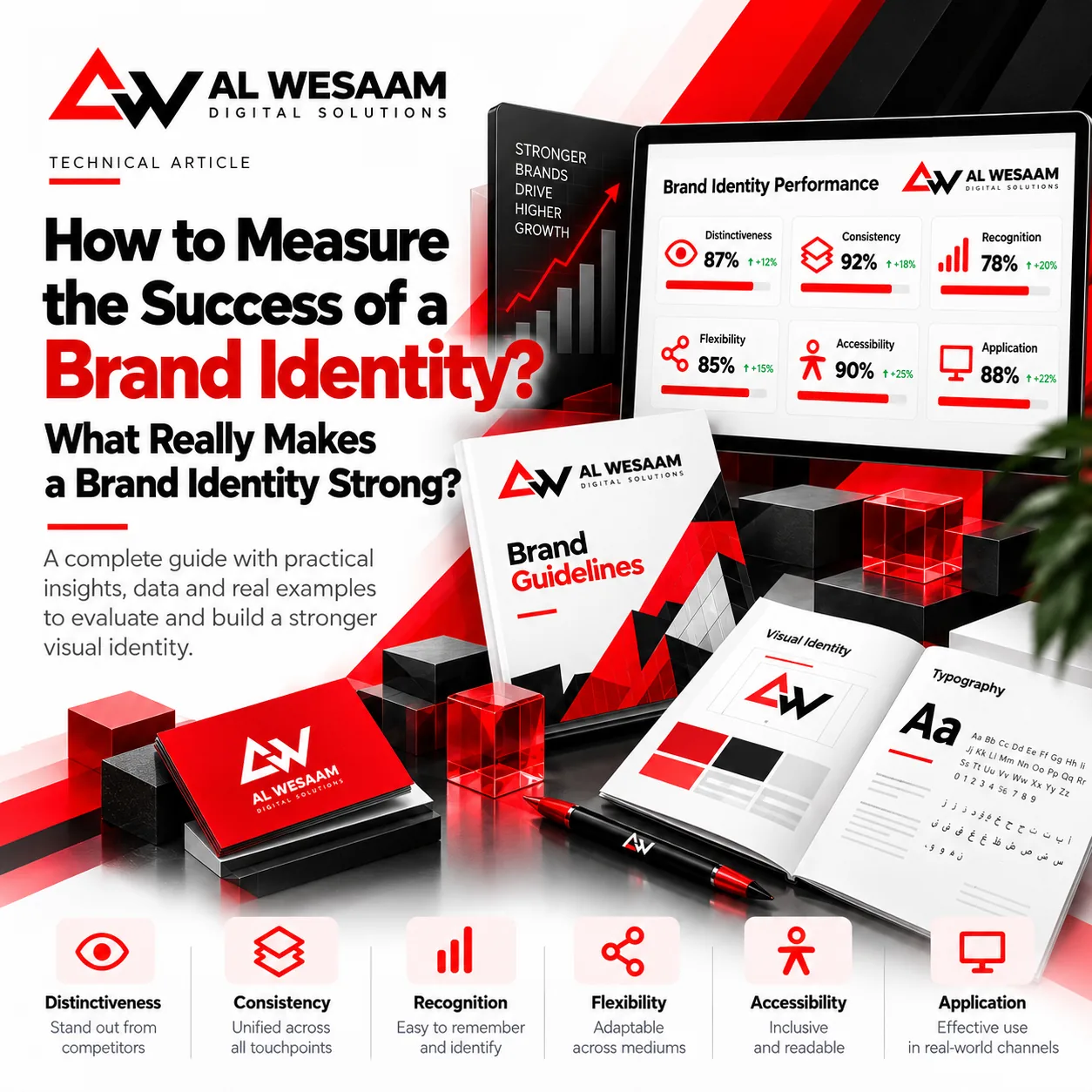
The percentages on the cover are illustrative, not AL WESAAM results or universal benchmarks. Use project data and consistent definitions rather than copying arbitrary scores.
Define the objective and baseline first
Do you want better recognition, less visual inconsistency, or easier production? Define the objective before collecting numbers. A useful metric answers a specific question and can lead to action.
Record current assets, the number of audited materials, audience characteristics, channels, and time period. Repeat with the same method where possible, documenting concurrent changes such as advertising campaigns or product launches.
Distinctiveness: does the asset point to your brand?
Distinctiveness is not about looking unusual. It is about people associating an asset with the correct brand rather than competitors. Assets may include shapes, patterns, color combinations, or characters, not just logos.
Present selected elements without the brand name and ask an open question: "Which brand does this remind you of?" Record correct associations, competing brands, and no association. Test assets separately where useful and avoid hints that inflate the outcome.
Report participant numbers and selection methods. Employees do not represent the market, and a new asset with little recognition is not necessarily unsuccessful: it may need consistent exposure before long-term evaluation.
Consistency: compare outputs with approved rules
Sample websites, social posts, presentations, and print. Review logos, fonts, colors, imagery, and voice against the guide, recording deviations, their impact, and an owner for each correction. Distinguish approved channel adaptations from actual violations.
Calculate adherence using applicable checks that passed, excluding non-applicable checks from the denominator. Do not treat all issues as equally serious: an obsolete homepage logo matters more than a minor spacing difference in an internal document.
Recognition and recall: keep the questions separate
Recognition is measured when people see a brand or one of its assets. Unaided recall measures whether they mention the brand without seeing options or a logo. Top-of-mind awareness means it is the first name mentioned for a category.
Ask unaided questions before showing options or assets to avoid priming. Keep wording, category, and sample comparable between waves. Knowing a name is not the same as liking the brand or intending to buy.
| Metric | Example question | Calculation |
|---|---|---|
| Asset association | Which brand does this element remind you of? | Correct brand associations / participants × 100 |
| Unaided recall | Which brands do you know in this category? | Unprompted brand mentions / participants × 100 |
| Top of mind | Which brand comes to mind first in this category? | First mentions of the brand / participants × 100 |
Flexibility: does the identity work in different contexts?
Test small and monochrome logos, long mobile headings, profile images, print, and Arabic and English text. Flexibility means having suitable variants and rules, not changing the identity for every use.
Record failure points: details disappearing at small sizes, unsupported diacritics, templates unable to accommodate translation, or colors failing on dark surfaces. Fix the underlying asset or rule instead of patching each output independently.
Accessibility: measure tests rather than impressions
Test foreground/background contrast, resizing, keyboard navigation, and status messages that do not depend on color alone. Review meaningful image alternatives and the needs of audio and video content.
A contrast-test pass rate is not an overall "WCAG compliance percentage." Automated tools cannot find every problem: add manual review and usability testing, documenting scope and covered pages.
The logotype contrast exception does not exempt ordinary website buttons or links. Record individual outcomes and findings instead of using one aggregate score that conceals critical issues.
Application, coverage, and production efficiency
Check whether approved identity assets reached actual channels rather than only a presentation. Track current template usage, asset discoverability, obsolete versions, production time, and correction rounds.
Define required channels before calculating coverage. A channel the business does not use should not automatically enter the denominator. Track coverage separately from implementation quality: having a logo everywhere does not mean using it correctly.
An audit template and a worked example
Create a register with the asset or page, check, result, finding, priority, owner, and correction date. Use "pass / needs correction / not applicable" rather than forcing every check into a binary result.
A hypothetical example only: if 80 out of 100 materials pass every applicable check, material adherence is 80%. If 450 out of 500 applicable checks pass, check adherence is 90%. These measure different things; do not switch definitions between reports.
| Audit area | Practical question | Possible action |
|---|---|---|
| Logo | Are version, proportions, and background approved? | Replace old assets and update templates |
| Color and type | Are values, weights, and roles correct? | Align tokens and templates |
| Language and voice | Are meaning and tone consistent in both languages? | Review copy and shared terminology |
| Accessibility | Do content and functions pass defined tests? | Resolve the barrier and retest |
| Assets | Can the team find the approved version? | Organize the library and clarify versions |
From measurement to improvement, without causal overclaims
Prioritize findings by impact, assign actionable improvements, and repeat measurement after an interval suited to production volume and audience exposure. Recognition, adherence, and production time can share a dashboard while keeping separate definitions.
Higher engagement or sales after an identity update does not establish that identity alone caused the change. Consider pricing, promotions, audiences, spend, and channels. For A/B testing, define the variable and keep other conditions as stable as possible.
The objective is not an attractive report score. It is understanding what identifies the brand, where implementation breaks down, and what needs to change in the system or team training.
Frequently Asked Questions
Is there one ideal success score for every identity?
No. Targets vary with market, brand maturity, and measurement method. Use a baseline, consistent definitions, and clear priorities.
Are the cover percentages real results?
No. They are illustrative cover elements, not AL WESAAM performance data or general benchmarks.
Is liking the logo enough?
No. Preference is one perception measure; recognition, clarity, adherence, and flexibility need separate testing.
How often should an audit be repeated?
After meaningful changes and at intervals suited to production volume and channel complexity. Review high-use templates before major campaigns.
Related Articles9
Review your identity with clear goals and an implementation plan
Discuss the assets and channels that need review with AL WESAAM, then define the scope for identity development, guidelines, and templates.