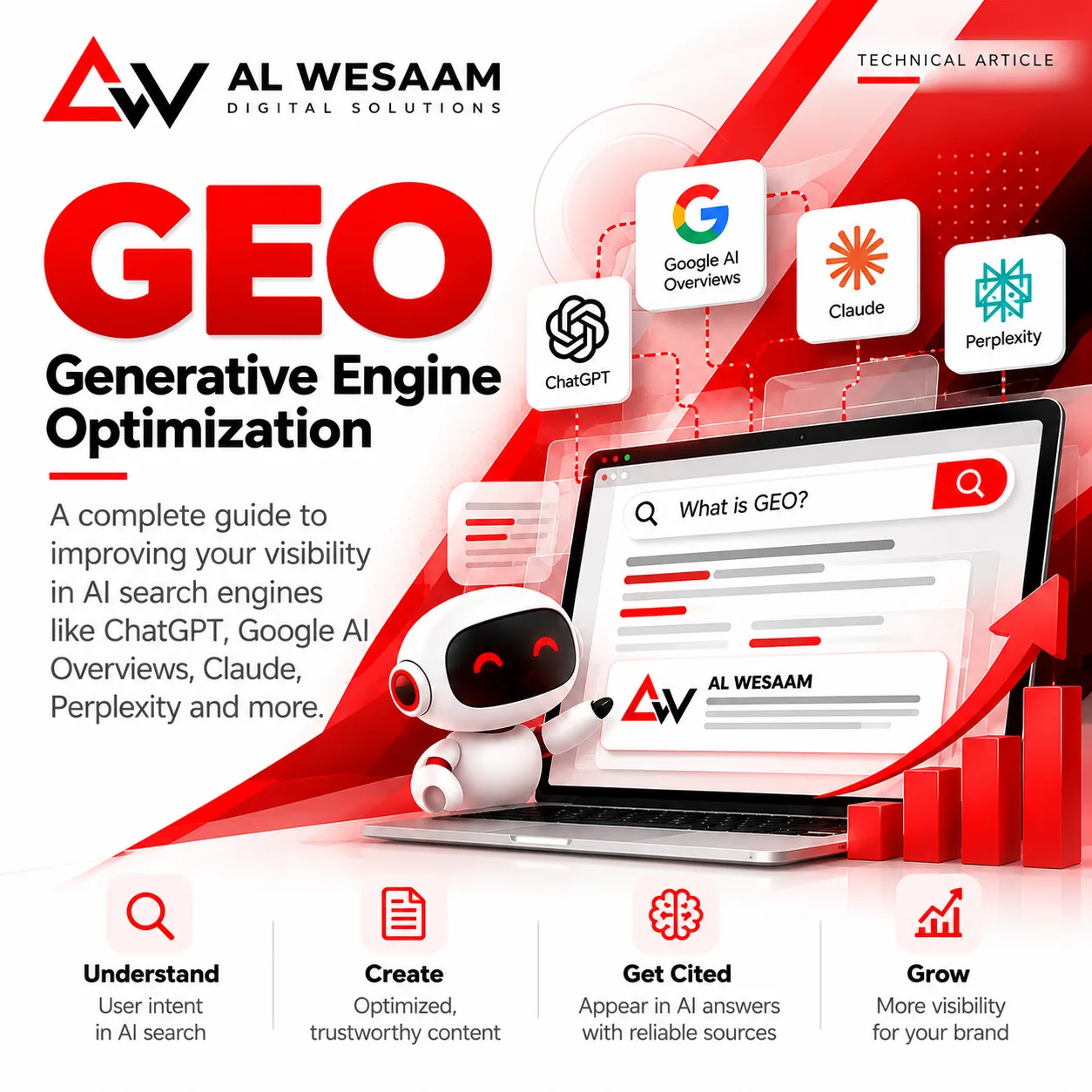
What Is GEO? A Practical Guide to Generative Engine Optimization
GEO stands for Generative Engine Optimization: improving content and digital presence so they are more likely to be discovered and used in AI-generated answers. It does not guarantee citations or replace SEO. It adds emphasis on clear, credible information that can be attributed to its source.
Key Takeaways
Useful content answers a specific question, distinguishes evidence from opinion, and offers original value that readers can verify.
The technical foundation matters: crawlable text, clear internal links, and a usable mobile experience. Measurement requires repeated tests, not one successful answer screenshot.
What does GEO aim to improve?
Traditional search often presents a list of links for the user to explore. A generative search experience may instead synthesize several sources into an answer. Readers may follow its citations or remain within the answer, making the quality of that source presence relevant alongside page rankings.
Here, GEO specifically means Generative Engine Optimization, not another use of the acronym. The practical objective is understandable, retrievable, attributable content, not repeated mentions of the term.
From question to answer: a conceptual workflow
A useful conceptual sequence is a question, information retrieval, selection of relevant sources, and answer generation that may include links or citations. This is a simplified model, not a universal specification for every platform.
Not every answer uses live web search, and platforms do not select sources identically. A single workflow therefore cannot become a guaranteed recipe for visibility in ChatGPT, Google AI, or Perplexity.
SEO, AEO, and GEO compared
| Concept | Focus | What to monitor |
|---|---|---|
| SEO | Page discovery, indexing, and search rankings | Impressions, clicks, and conversions |
| AEO | Direct, understandable answers to user questions | Answer clarity and relevance |
| GEO | Source or brand presence in generated answers | Citations, mentions, and resulting visits |
Answer first, then add depth
Start with a short, self-contained definition, then explain when the concept applies and where its limits lie. Follow with an example, comparison, or implementation steps. This serves the reader before any automated system.
Rather than opening with general claims about the future of marketing, define GEO directly and explain its relationship to SEO. Use descriptive headings and make abbreviations understandable even when a paragraph is read on its own.
Evidence matters more than keyword repetition
The foundational GEO paper introduced an experimental framework for measuring source visibility. It is not a commercial guarantee that every edit works on every platform; outcomes depend on context and measurement. Read the original research before turning a published percentage into a client promise.
In practice, connect claims to sources, add original examples or data when available, and state limitations. Do not invent search volumes, case studies, or reviewers. Editorial judgment and implementation suggestions should be recognizable as such.
Prepare the site for discovery
- Check that important pages return successful responses and are not accidentally blocked or marked noindex.
- Keep definitions and essential content in HTML text, not only inside images.
- Connect related pages and use accurate titles and descriptions rather than generic slogans.
- For multilingual sites, publish real Arabic and English pages with reciprocal hreflang links and an appropriate canonical for each version.
- Fix mobile, link, and image issues, and keep article structured data consistent with visible content.
Do you need special AI schema?
Google states that AI Overviews and AI Mode do not require new AI files or special schema. Meeting requirements does not guarantee indexing or display. Use structured data to describe real content, not as a shortcut to rankings.
Search crawling and model training are different
OpenAI distinguishes OAI-SearchBot for search features from GPTBot for training-related crawling. Review each crawler policy before changing robots.txt, and check CDN and security rules too. A permission in one layer cannot overcome a block elsewhere, and crawl access does not guarantee source selection.
Source: OpenAI: crawler overview
Measure a pattern, not a single screenshot
Create a stable set of audience questions in the relevant languages and markets. Record the platform, test date, and exact prompt. Repeat tests and distinguish a brand mention from a linked citation and an actual site visit.
Track clicks and conversions in analytics and Search Console against an earlier baseline. Google AI feature activity is included within general web search reporting; a change in that report alone does not prove that GEO caused a sales increase.
A practical starting plan
- Choose genuine recurring customer questions and map each to the most suitable page.
- Edit a concise answer and add useful examples, comparisons, and verifiable sources.
- Review access, indexing, internal links, and language versions.
- Record a baseline, then repeat tests across sessions and platforms after the update.
- Refresh changing information and retain content that helps readers even when it receives no AI citation.
Frequently Asked Questions
Does GEO replace SEO?
No. Page discovery, understanding, and content quality remain essential. GEO adds attention to how a source is used in generated answers.
Can you guarantee visibility in ChatGPT?
No. Selection varies by question, platform, and available sources. You can improve readiness and test outcomes, not guarantee every answer.
Does repeating GEO improve results?
Artificial repetition adds little value. Prefer accurate definitions, useful answers, original examples, and clear sources.
Related Articles9
Is your content clear enough to be a useful source?
Discuss your content structure, technical foundation, and language versions with AL WESAAM, using measurable objectives rather than ranking promises.